0 events found.
Little St. Simons Island
Events at this venue



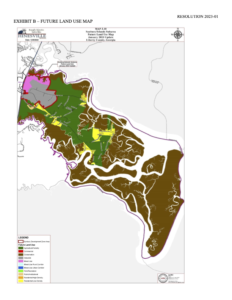 Here you see East Liberty County’s recently adopted land use map. The gray area is Sunbury/Islands Subarea—where most of the industrial rezoning has taken place. Over the last several months, in accordance with this map, many agricultural zones (demarcated in green) have been rezoned into industrial (gray), which immediately abut the residential zones (yellow and orange). The proposed commercial zones (red) are insufficient to provide any sort of adequate buffer for the existing communities, not to mention any that will be built to house the workforce drawn to Liberty as industry grows.
Transition zones are a way to taper land use from “heavy” (think industrial: 24-hour lights, traffic from trucks, noise from machinery and operations) to “medium” before hitting the “light” use (think residential: commuter car traffic, schools, playgrounds). These transition zones can be commercial, containing local businesses and public spaces; character areas, combining the more condensed development of town homes with green spaces; or even conservation areas. They are vital for maintaining community health, safety, and personality, as well as conserving land for native and migratory species.
Adventurous, Creative, Assiduous
I don’t know exactly what it is I want to pursue later in life, but I know I want it to be something that gives me the freedom to travel and explore the world while still making a difference. I want to do something that allows me to be creative and pursue my passions, something more than just a standard desk job.
I’ve participated in South Carolina’s Olympic Development Program for soccer for the past two years.
My favorite place probably has to be Saint Simon’s Island. It’s not just about how beautiful and serene it is, though. I like how being there makes me feel. I like that it makes me feel at peace with myself and lets me escape from the world around me.
I think that major coastal issues to be concerned about primarily surround plastic pollution and the degradation of beaches and coastal lands. There are so many issues that are important and worthwhile, but I feel that plastic pollution is especially important. It threatens wildlife and chemicals leeched can harmfully impact human health, as well.
You are never too small to make a difference. Every movement and every change in history has started with one action, one idea, that was built upon to create change. All contributions, big or small, have the power to make a difference.
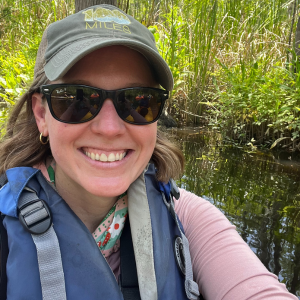
Stephanie’s love for the ocean started at a very young age on the beaches of Stone Harbor, New Jersey, searching for and collecting shells with her Nana. This childhood passion never stopped, and she followed her interest in the outdoors by pursuing a degree in Marine Science from American University in Washington, D.C.
After college, Stephanie spent time teaching environmental science in Florida, California, and Georgia. Ultimately settling on the Georgia coast, she worked at Driftwood Education Center on St. Simons Island as the Program Director and later with the Georgia Department of Natural Resources as a Naturalist on Sapelo Island. Stephanie continues to share her love of our coast as a part of the One Hundred Miles education team.
Cumberland Island, where my love for the coast began
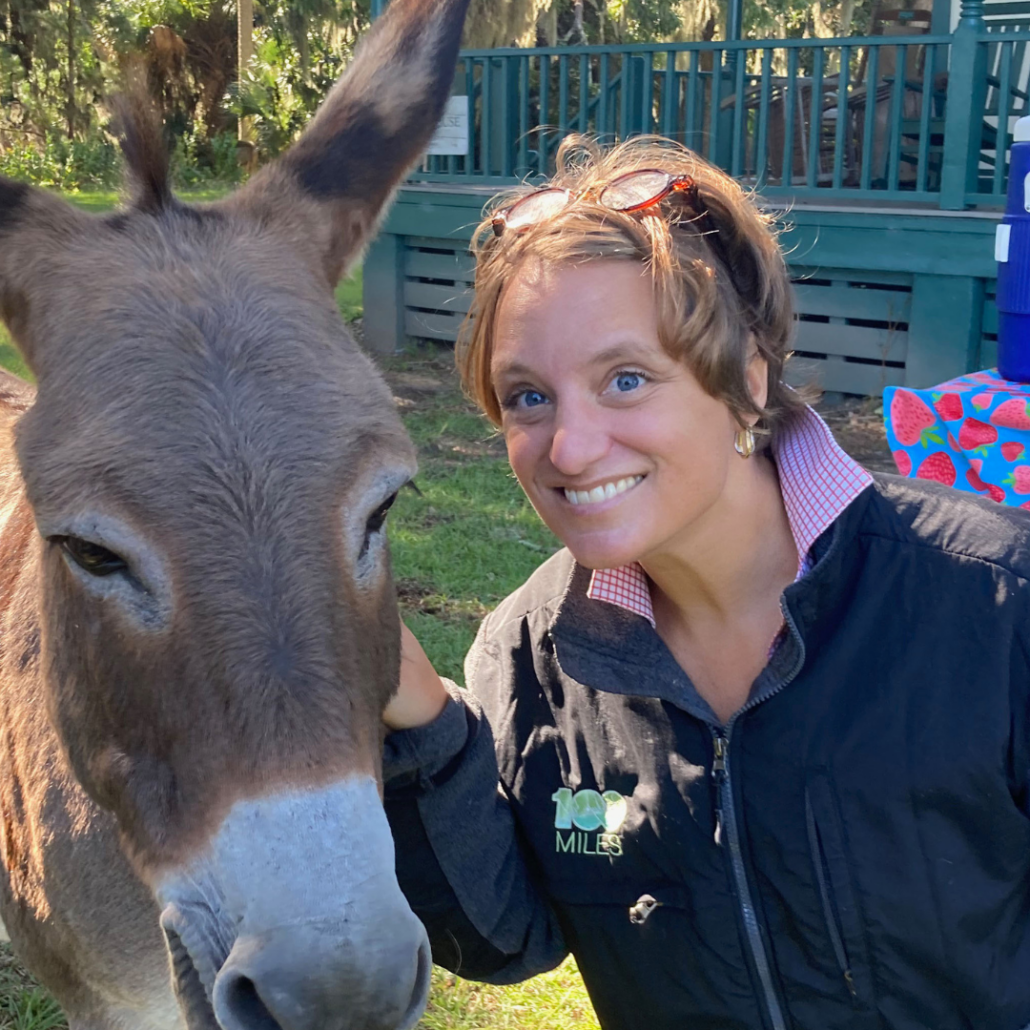
Megan Desrosiers is the founding President/CEO of One Hundred Miles, Georgia’s coastal advocacy organization. In an effort to elevate the Georgia coast as a recognized place of historical, cultural, and biological significance, Megan spends her time working in local communities, on regional collaboration projects, and lobbying in Atlanta.
Megan and her team have accomplished a remarkable amount since the organization’s inception ten years ago. One Hundred Miles is responsible for improvements to the Erosion and Sedimentation Act which now requires a 25-foot buffer for all salt marsh, galvanizing statewide opposition to offshore drilling, preventing the US Army Corps of Engineers from dredging during the summer when Georgia’s sea turtles come home to nest, and leading citizens’ efforts to stop Spaceport Camden and repeal harmful zoning on Sapelo Island. Under her leadership, One Hundred Miles has built a network of more than 35,000 advocates who stand ready to respond to bad and promote good ideas that will affect our coast. In six short years, the organization has grown from two employees to 14, an annual budget of $250,000 to more than $1.5 million, and a donor base of six to one of more than 1,200 today.
Before coming to Georgia’s coast, Megan spent ten years at the Coastal Conservation League (CCL) in South Carolina. She was instrumental in efforts to conserve land in the Ashley River Historic Corridor and on Johns Island. She also worked to establish the organization’s first climate and energy and agriculture program agendas.
Megan has worked through the years to help start up organizations form and become sustainable coastal advocacy partners in Georgia and South Carolina. In addition to forming One Hundred Miles, she worked with a team to start GrowFood Carolina, South Carolina’s first local food hub, and collaborated with a group of diverse leaders to initiate Charleston County’s Greenbelt Program. Megan has also served on the founding boards of the South Carolina Outdoor Education Program (SCOEP) and Charleston Moves, a bicycle/pedestrian advocacy organization.
In 2024, Megan was honored with the James S. Dockery, Jr. Southern Environmental Leadership Award from the Southern Environmental Law Center for her excellent and longstanding environmental leadership in the Southeast.
Forsyth Park in downtown Savannah